
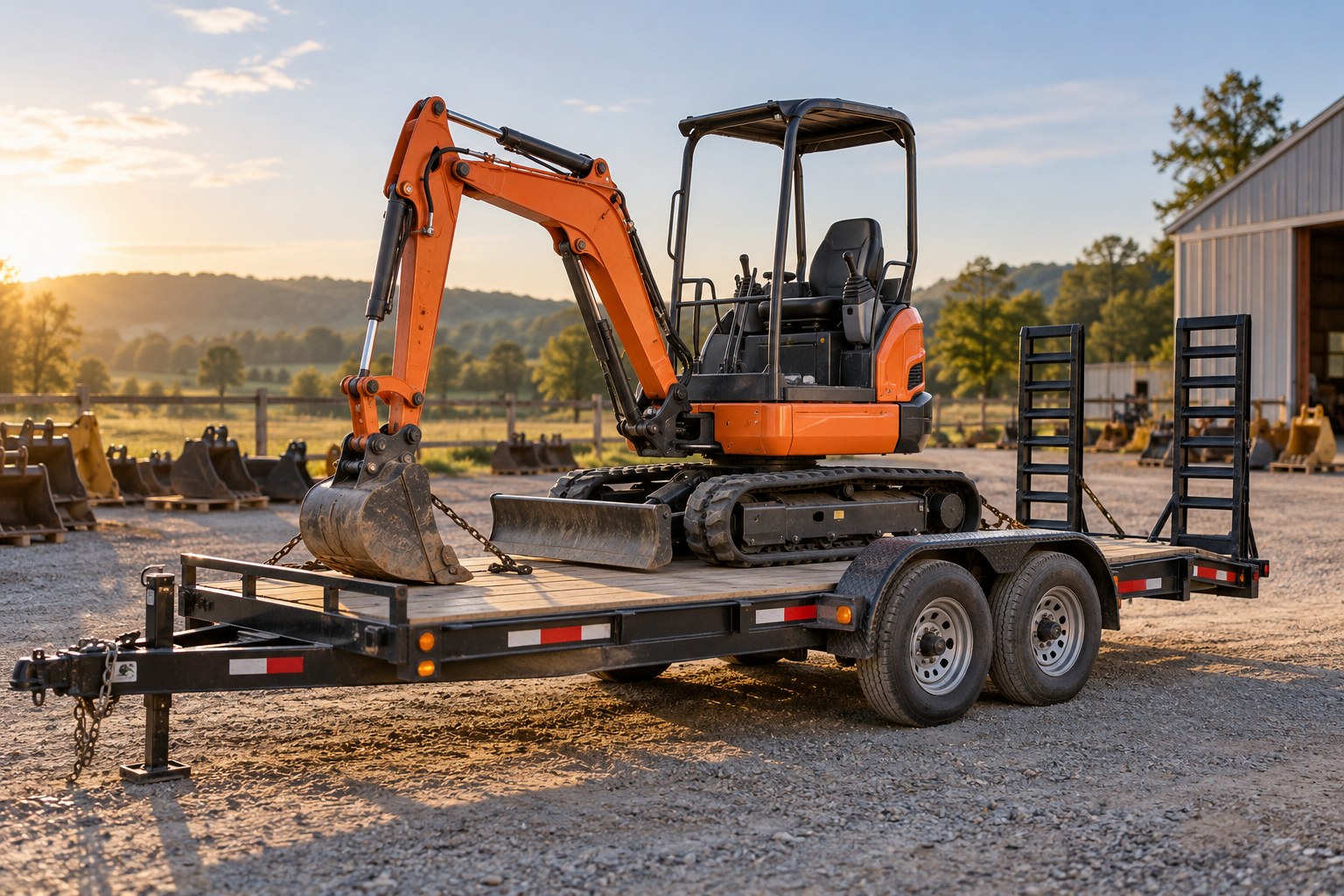
Choose a mini-excavator trailer by its usable payload and deck dimensions, then match the loaded trailer to the exact truck’s ratings. A “14K trailer” has a 14,000-pound gross vehicle weight rating, not 14,000 pounds of cargo capacity. Subtract its empty weight and count the excavator, attachments, fuel and hauling gear. The machine must also fit the deck and ramps. There is no trailer or pickup class that works for every mini excavator, because configurations and actual weights vary substantially.
Quick Answer
| Check | Use this number | Common mistake |
|---|---|---|
| Trailer payload | GVWR minus actual empty trailer weight | Treating GVWR as cargo capacity. |
| Machine cargo | Configured machine plus extra attachments and gear | Using a bare-machine brochure weight. |
| Truck limits | Tow rating, GCWR, payload and axle ratings | Checking advertised tow capacity alone. |
| Physical fit | Track width, transport length and height | Checking weight but ignoring ramps or deck size. |
| Legal operation | Applicable license, registration and securement rules | Assuming a small excavator means no commercial rules. |
Calculate the Weight You Will Actually Move
Use the specifications and manual for the excavator’s exact configuration. Cab versus canopy, counterweights, blade options, buckets and other attachments can change the load. Confirm what is already included in the published operating weight so you do not add a bucket twice or overlook one excluded from the figure. A scale ticket is useful when a used machine’s configuration is uncertain.
Add separately carried buckets, a hydraulic breaker, spare parts, chains, binders and tools. Mud stuck to the tracks and other accumulated material can also change the real load. Clean the machine before transport and weigh the working setup when needed. The Bobcat compact-excavator transport guide emphasizes matching the transport vehicle to the equipment and accounting for attachments.
Before buying, compare the specifications of new and used excavators for sale with your hauling limits. If your existing truck cannot handle the machine, include professional transport or a different tow vehicle in the purchase budget. Our used-equipment buying guide puts transport alongside inspection and ownership checks.
Subtract Trailer Weight Before Comparing Ratings
The first calculation is trailer GVWR minus its actual empty weight. Trailer accessories added after manufacture can consume capacity, so use current documentation or a scale rather than a guessed empty weight. Axle, tire, hitch, coupler, ramp and deck limits still apply; the payload calculation does not replace those checks.
Consider an illustrative 14,000-pound-GVWR trailer weighing 3,500 pounds empty. Its arithmetic payload is 10,500 pounds. An 8,000-pound configured excavator, 800 pounds of extra buckets and 200 pounds of hauling gear total 9,000 pounds of cargo. The loaded trailer weighs 12,500 pounds. That passes the gross-weight comparison, but says nothing yet about axle loading, ramp capacity or truck suitability.
If a different trailer weighs 5,000 pounds empty, the same 14,000-pound rating leaves only 9,000 pounds for cargo. That puts this example at the rating before any overlooked items. Compare actual specifications and leave practical room for the equipment you routinely carry. Never exceed a rating because the trip is short.
Check Truck Payload, Hitch Load and Combined Weight
Find the tow rating and gross combination weight rating for your truck’s model year, engine, axle ratio, drivetrain and towing equipment. Also read the actual truck’s payload label and axle ratings. Passengers, tools, bed cargo, hitch hardware and trailer tongue or pin load all affect the truck’s available capacity.
The Ford towing-guide library illustrates why configuration matters; use the corresponding manufacturer’s manual for your vehicle. The limit is the weakest applicable component or rating, not the largest towing figure in an advertisement. A bumper-pull trailer and a gooseneck also impose different hitch and truck-loading requirements.
Have the loaded combination weighed to verify truck, trailer and axle loads. Position the excavator according to the equipment and trailer manufacturers’ instructions. Moving it forward or backward changes hitch and axle loading; being below total GVWR does not mean every axle is within its rating. Our skid-steer trailer and truck guide explains the same weight principles for compact loaders.
Confirm Deck Fit, Securement and Driver Requirements
Measure the excavator in its prescribed transport position. Check track width, deck width, ramp width and capacity, overall length, folded boom height and room for extra attachments. Retractable tracks do not remove the need to follow the loading instructions. Confirm the trailer supports concentrated track loads and has rated tie-down points in usable locations.
Plan loading on firm, level ground and follow the machine’s operation and maintenance manual. Use approved securement points and rated equipment; secure loose attachments separately as required. FMCSA’s cargo-securement guidance explains the federal requirements for equipment where they apply. A photograph of a parked machine on a trailer is not a complete securement plan.
Finally, check the combination’s licensing, registration, braking, inspection, dimension and permit requirements. Commercial use and vehicle ratings matter even with a compact machine. Read our plain-English CDL guide for the rating framework, then confirm the rules for your exact trip with the relevant authorities.
Planning guidance only. Exact vehicle ratings, manufacturer instructions and applicable state and federal transport rules control.
Frequently Asked Questions
Is a 14,000-pound trailer enough for a mini excavator?
→
It depends on empty trailer weight and the complete cargo load. Subtract empty weight from GVWR, then check axle, tire, deck, ramp and hitch limits as well as truck ratings.
Can a half-ton pickup tow a mini excavator?
→
Some small combinations may fit particular truck ratings, but the truck class name does not answer the question. Check the exact vehicle configuration, loaded trailer weight and available truck payload.
Should I use operating weight or shipping weight?
→
Use the actual configuration being transported. Check what each published figure includes, account for fuel, attachments and hauling gear, and weigh the setup when documentation is unclear.
Ready to shop?
See new and used excavators for sale from sellers across the country.


